Industry News
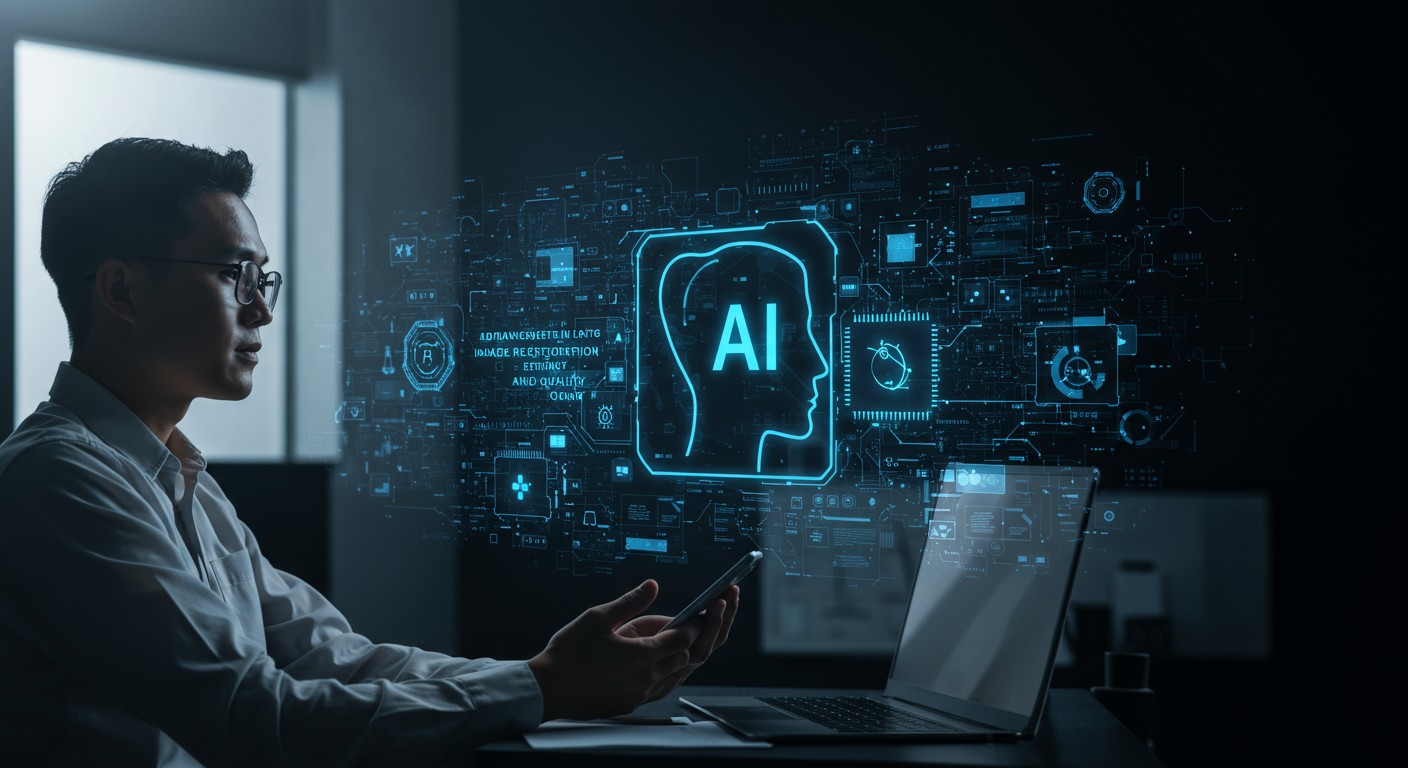
Advancements in AI Image Restoration: Enhancing Efficiency and Quality
Recent developments in AI-driven image restoration, such as INHA University's FAST-DIPS, are revolutionizing the field by improving efficiency and quality. These innovations, alongside tools like PixelDojo's Reality Polisher and Image Outpainting, are making high-quality image restoration more accessible and effective.
Introduction
The field of image restoration has witnessed significant advancements with the integration of artificial intelligence (AI). Traditional methods often required extensive manual effort and expertise, but recent AI-driven techniques have streamlined the process, enhancing both efficiency and quality. A notable development in this domain is the introduction of 'FAST-DIPS' by a research team at INHA University, which leverages diffusion models to address complex image inverse problems more effectively.
The Emergence of FAST-DIPS
Professor Lim Hongki and his team at INHA University have developed 'FAST-DIPS,' an AI technology designed to tackle image inverse problems—challenges that involve reconstructing original images from degraded or partially observed data. Traditional diffusion model-based restoration techniques often face limitations, such as high computational costs and the need for repetitive gradient calculations. FAST-DIPS addresses these issues by providing a more efficient and stable solution, making it applicable across various computer vision and scientific fields that require rapid, high-quality image reconstruction. (qs-gen.com)
Broader Trends in AI Image Restoration
The development of FAST-DIPS is part of a larger trend in AI image restoration. The market has seen substantial growth, with major players like Tencent, Adobe, Remini, NVIDIA, and Topaz Labs competing in areas such as color restoration, content restoration, and commercial photography. The AI image enhancer market expanded from $2.45 billion in 2025 to $2.83 billion in 2026, driven by trends like high-resolution image restoration. (jenova.ai)
Challenges and Solutions in AI Restoration
Despite these advancements, challenges remain. Many AI systems can cleanly generate representations of images but may fail to capture the specific details that make a restored image feel authentic. This issue arises because AI lacks personal context and history, leading to restorations that, while technically improved, may not resonate with individuals' memories. (foreverstudios.com)
To address this, companies like Jenova have developed specialized AI agents that understand the domain-specific requirements of different restoration tasks. These agents, combined with conversational refinement, keep users in creative control, ensuring that restorations meet personal expectations. (jenova.ai)
PixelDojo's Contributions to AI Image Restoration
PixelDojo offers a suite of tools that align with these advancements, providing users with powerful options for image restoration and enhancement:
-
Reality Polisher: This tool removes AI artifacts through iterative refinement, ensuring that restored images maintain their authenticity and align with users' memories. (jenova.ai)
-
Image Outpainting: By extending images beyond their original borders, this tool allows users to reconstruct missing parts of an image, effectively addressing issues like torn or incomplete photographs. (jenova.ai)
-
Creative Upscaler: For images that have lost resolution over time, this AI-enhanced upscaling tool increases image resolution while preserving detail, making old photos suitable for modern displays. (jenova.ai)
Future Directions
The future of AI image restoration is poised for further innovation. Emerging technologies like M2IR and ClearAIR are introducing proactive, all-in-one restoration frameworks that address multiple degradation types simultaneously. These models employ advanced architectures, such as Mamba-style modulation and mixture-of-experts, to enhance adaptability and generalization across diverse restoration tasks. (arxiv.org)
Additionally, the integration of human-visual-perception-inspired strategies, as seen in ClearAIR, aims to produce restorations that are not only technically accurate but also visually pleasing and contextually appropriate. (arxiv.org)
Conclusion
The landscape of AI-driven image restoration is rapidly evolving, with innovations like FAST-DIPS and tools from PixelDojo enhancing both the efficiency and quality of restoration processes. As these technologies continue to develop, they promise to make high-quality image restoration more accessible, allowing individuals and professionals alike to preserve and enhance visual memories with unprecedented ease and accuracy.
Original Source
Read original articlePremium AI Tools
Create Incredible AI Images Today
Join thousands of creators worldwide using PixelDojo to transform their ideas into stunning visuals in seconds.
125
Creative AI Tools
4M+
Creations
60+
AI Video Models